
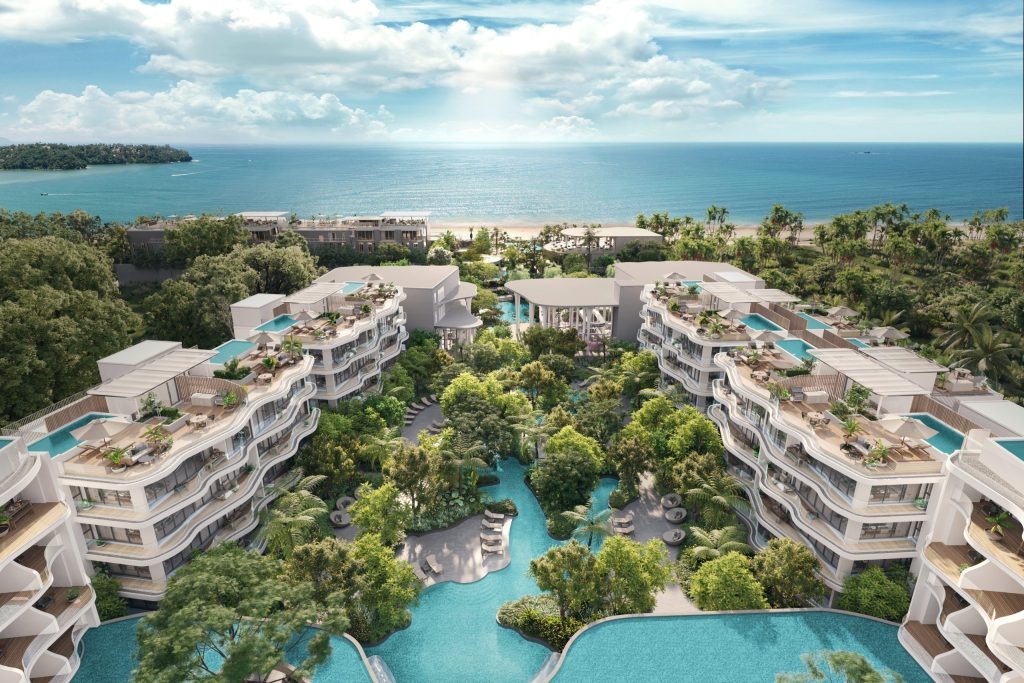
Few luxury destinations in Southeast Asia carry a backstory as unlikely as Laguna Phuket. Today the name is synonymous with manicured lagoons, championship golf, and some of the island’s most sought-after residential addresses. Four decades ago, the same stretch of land at Bang Tao Bay was written off as unusable: a derelict tin mining site, stripped bare and poisoned by decades of extraction. The transformation from industrial wasteland to premier resort community is not just a curiosity of Phuket history. It is the foundation that makes the area’s real estate market as stable and well-regarded as it is today, and it explains why so many investors researching buying property in Laguna Phuket start by asking how the destination came to exist in the first place.
From Tin Mine to Toxic Wasteland
Tin mining shaped much of Phuket’s early economy, and Bang Tao was one of its most heavily worked sites for the better part of a century. By the time global tin prices collapsed in the early 1980s, the industry had left behind a landscape of flooded pits, acid-laced water, and soil so degraded that agricultural surveyors considered it a lost cause. The lagoons that now anchor the resort’s identity were, in their original form, contaminated mining ponds. Local fishermen reportedly warned that nothing would ever grow there again.
It was against this bleak backdrop that a Singapore-based couple, Ho Kwon Ping and Claire Chiang, acquired the land in 1984, drawn by its scenic bay setting and largely unaware of the environmental damage until after the purchase was complete. Rather than abandon the project, they committed to a multi-year rehabilitation program. Environmental specialists were brought in to treat the acidic water, thousands of trees were planted to stabilize the soil, and the old mining pits were gradually reshaped into the interconnected lagoons that give the destination its name.
Building Asia’s First Integrated Resort
The cleanup alone took several years, but it set the stage for something far more ambitious than a single hotel. In 1987, the development opened as Laguna Phuket, widely credited as Asia’s first fully integrated destination resort. Rather than a standalone property, it was conceived as a connected community of hotels, golf, dining, and leisure facilities sharing infrastructure and amenities across the reclaimed land.
The first hotel to open on the site set the tone for what would follow, and additional resorts were added through the early 1990s, including an 18-hole golf course that remains part of the destination today. One of the boldest moves came when the developers, unable to secure a beachfront plot for a planned new hotel, pioneered the idea of an all-villa property built entirely around private pools rather than standard guest rooms. That concept became a signature of luxury hospitality across Asia and helped cement the surrounding area’s reputation for architectural ambition.
Over the following decades, Laguna Phuket expanded well beyond its original hotel footprint. Today the destination spans roughly a thousand acres between Bang Tao and Layan beaches and includes multiple resort brands, two golf courses, a retail and dining precinct, international schools, medical clinics, and a permanent expatriate population large enough to function like a self-contained town. What began as an experiment in environmental restoration has grown into one of the most established residential and lifestyle communities on the island.
Why the History Matters to Today’s Buyers
For anyone evaluating buying property in Laguna Phuket, this origin story is more than a piece of local trivia. It explains three characteristics of the market that set it apart from newer developments elsewhere in Phuket.
The first is infrastructure maturity. Because the area was master-planned from the outset rather than built up piecemeal, roads, utilities, landscaping, and amenities were designed to work together. Decades of continuous investment have kept that infrastructure current, rather than leaving early buyers stuck with an aging or incomplete environment.
The second is brand continuity. Several of the resort operators that opened properties in Laguna Phuket during the late 1980s and early 1990s still operate there today, and international hospitality groups have continued to add new properties and residential phases well into the 2020s. That kind of long-term commitment from established operators is a signal that seasoned developers and hoteliers see lasting value in the location, not just a short-term opportunity.
The third is community depth. A destination with schools, clinics, retail, and a settled expatriate population offers a different lifestyle proposition than a resort area built purely around tourism. Buyers looking for a place to live part-time or full-time, not just an investment to rent out, tend to weigh this kind of established community heavily.
What the Property Market Looks Like Today
The residential offering within and around Laguna Phuket has diversified considerably since the resort’s early years. Branded pool villas, echoing the concept pioneered there in the 1990s, remain a defining product type, typically set within landscaped grounds close to the lagoons or golf courses. Alongside these sit lower-density villa communities aimed at long-term residents, as well as newer branded residence and condominium projects that pair hotel-style services with private ownership.
Property in this part of Bang Tao tends to command a premium compared with other parts of the island, a reflection of the area’s scarcity of remaining land, its established reputation, and the ongoing demand from both holiday buyers and long-term residents. Larger master-planned phases have continued to be released in recent years, extending the original footprint and adding new neighborhoods, retail space, and amenities designed to serve residents rather than only overnight guests.
For international buyers, the practical mechanics of ownership follow Thailand’s national framework rather than anything specific to the resort. Condominium units can generally be purchased freehold by foreign nationals, subject to a quota limiting foreign ownership within a given building. Landed villas, by contrast, typically involve a leasehold structure or a company-based arrangement, since foreign nationals cannot hold freehold title to land itself under Thai law. Anyone comparing options should treat these structures as a starting point for further due diligence rather than a substitute for advice from a licensed Thai lawyer, since terms and structures vary between projects and developers.
A Track Record That Still Matters
Real estate marketing often leans on words like “established” and “premier” without much to back them up. Laguna Phuket is one of the rare cases where the description holds up under scrutiny. A community that turned a toxic industrial site into one of Southeast Asia’s most recognizable resort destinations, and then sustained that reputation across four decades of continuous development, has already answered the questions that newer projects still have to prove: whether the location will hold its appeal, whether operators will stay committed, and whether the surrounding community will keep growing rather than stagnating.
None of this guarantees that any individual property will perform well, and pricing, unit type, and structure still deserve careful comparison before any purchase decision. But for anyone weighing the merits of buying property in Laguna Phuket against other parts of the island, the four-decade track record is a rare piece of due diligence that has already been done. Few destinations in Phuket, or anywhere in Southeast Asia, can point to a comparable story of transformation, sustained investment, and enduring demand.