
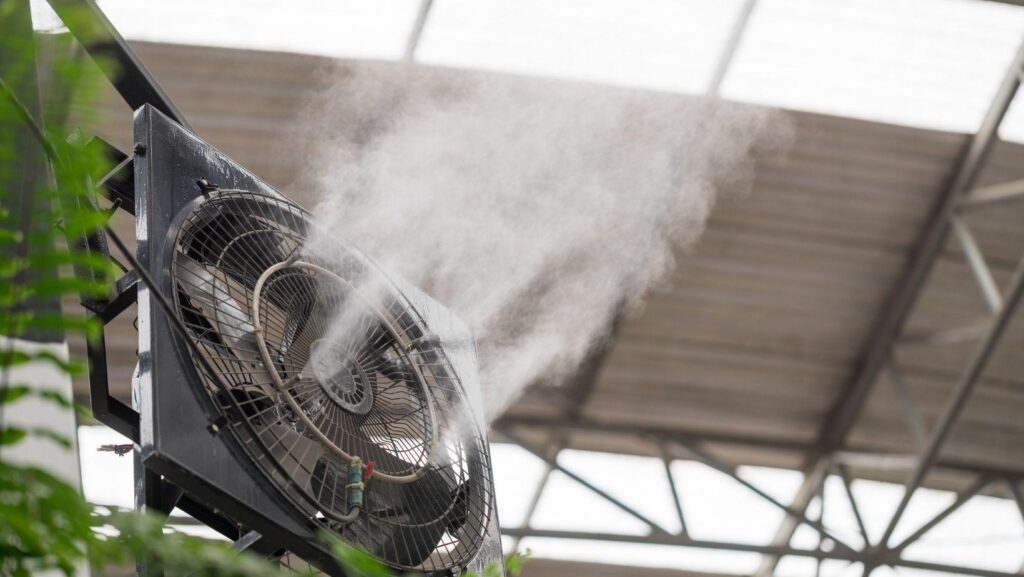
Standard fans move air without actually lowering its temperature, they just make existing heat feel more tolerable by increasing airflow across the skin. Misting fans work on a different principle entirely. By combining a fine water spray with a fan’s airflow, they use evaporative cooling to reduce the actual temperature of the air, not just the perceived temperature. This makes them a genuinely different tool from ordinary circulation fans, well suited to some settings and a poor match for others. Understanding the physics behind the cooling effect, and what conditions it depends on, helps buyers figure out whether a misting fan will solve a real problem or just add moisture to a space without much payoff.
The Science Behind Evaporative Cooling
Evaporative cooling relies on a simple physical principle: when water evaporates, it absorbs heat from its surroundings as it changes from liquid to vapor. A misting fan takes advantage of this by forcing water through tiny nozzles, breaking it into a fine mist rather than droplets, and then using the fan’s airflow to carry that mist through the air and speed up evaporation. As the droplets evaporate, they pull heat energy out of the surrounding air, and the fan spreads that cooler air across the space.
The finer the mist, the faster it evaporates and the stronger the cooling effect, which is why quality misting systems rely on high-pressure pumps and specialized nozzles rather than a basic spray attachment. Low-pressure systems tend to produce larger droplets that fall to the ground or land on surfaces before fully evaporating, wasting water and leaving floors wet without delivering much of a temperature drop. High-pressure systems, producing finer droplets, achieve a noticeably higher evaporation rate and a more meaningful reduction in air temperature for the same amount of water used.
Why Humidity Determines Effectiveness
Humidity is the single biggest factor in how well a misting fan actually performs. Evaporation happens because water molecules move from a liquid state into the surrounding air, and that process only continues efficiently when the air has room to absorb more moisture. In dry air, water evaporates quickly and carries a meaningful amount of heat away with it. In air that’s already humid, the atmosphere is closer to saturated, so evaporation slows and the cooling effect drops off sharply.
This is why misting fans see widespread use in arid and semi-arid climates but tend to underperform, or even work against comfort, in humid regions. A facility in a dry desert climate might see a substantial temperature reduction from a well-placed misting fan, while identical equipment installed in a coastal or tropical environment could produce only a marginal effect while adding uncomfortable dampness to the air. Buyers evaluating misting fans through a supplier such as Industrial Fans Direct should check regional humidity averages for the months the fan will see heaviest use, rather than assuming performance will match results from a different climate.
Environments That Benefit Most
Certain settings consistently get strong results from misting fans because they combine high heat, open or semi-open airflow, and typically lower ambient humidity. Common applications include:
In each case, the space either has natural ventilation to carry excess moisture away or is outdoors entirely, which keeps humidity from building up to the point where it undermines the cooling effect. Browsing misting fan options through equipment suppliers makes it easier to compare units built for these higher-demand outdoor and semi-outdoor settings against smaller residential-style models that aren’t designed for the same coverage or duty cycle.
What to Consider Before Installing a Misting Fan
Buyers weighing a misting fan against a standard circulation fan should think through a handful of practical factors beyond climate alone. Water supply comes first: misting systems need a consistent, clean source, and mineral content matters, since hard water can clog fine nozzles over time and require more frequent maintenance or filtration. Facilities without an easy plumbed water line may need tank-fed systems instead, which require regular refilling and add an ongoing task to facility upkeep.
Surface exposure is another consideration. Even well-designed misting systems produce some residual moisture, and equipment, electronics, or materials sensitive to humidity should be kept out of the direct mist zone or protected accordingly. Flooring in the coverage area may also become damp over time, which matters in settings where slip hazards are a concern, such as walkways or areas with regular foot traffic.
Nozzle quality and pump pressure affect both performance and long-term cost. Lower-cost systems using basic nozzles and weaker pumps tend to wet surfaces more while cooling less, while higher-pressure systems with quality nozzles cost more upfront but generally deliver better evaporation rates and less residual water on the ground.
Planning Placement for Maximum Effect
Positioning affects results as much as equipment quality does. Placing a misting fan where airflow can carry the mist across an open area, rather than into a corner or against a wall, allows more of the water to evaporate before settling, which improves cooling performance and reduces unwanted dampness on nearby surfaces. In outdoor dining or event spaces, angling units slightly downward and outward across the seating area tends to produce more even relief than aiming a single fan straight down onto one section.
For larger open spaces like warehouse loading zones or agricultural buildings, spacing multiple units at intervals based on their rated coverage radius, rather than clustering them in one area, spreads the cooling effect more evenly across the space people actually occupy. Facilities dealing with concentrated heat near specific equipment or work zones often get better results targeting units directly at those areas rather than trying to cool an entire structure uniformly.
Final Analysis
Misting fans offer a genuinely different cooling mechanism than standard circulation fans, using evaporation to lower actual air temperature rather than simply increasing airflow across the skin. That advantage depends heavily on climate, with dry or moderately humid environments seeing strong results and humid climates seeing diminished or even counterproductive effects. Outdoor dining areas, dry-climate warehouses, agricultural facilities, and outdoor work sites tend to be the strongest fits. Buyers considering installation should weigh water supply, nozzle quality, moisture exposure to nearby equipment or flooring, and regional humidity patterns before committing, since a misting fan installed in the wrong conditions can end up adding discomfort rather than relief.