
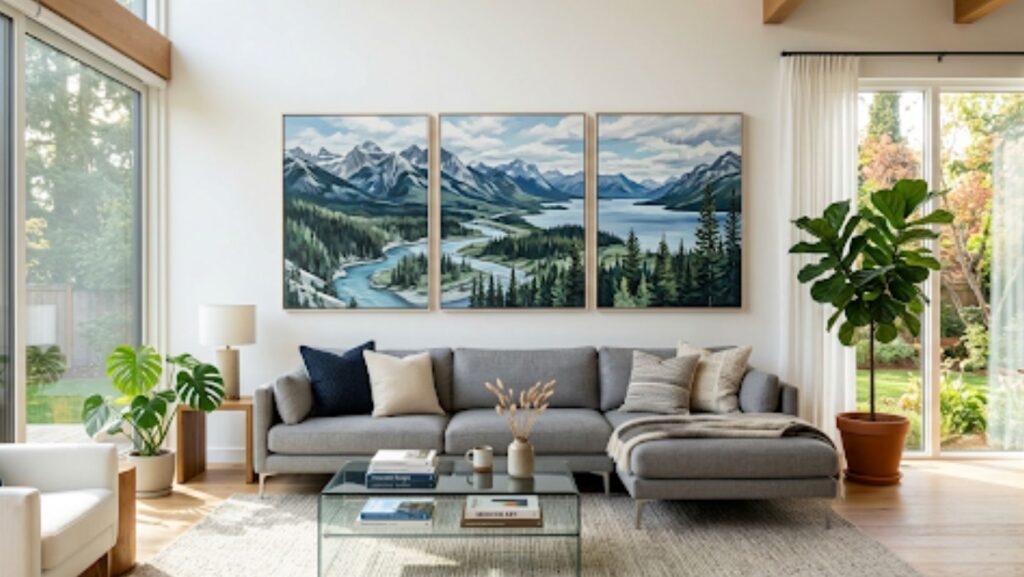
Bare walls are one of the most common complaints homeowners and property investors raise after a renovation — everything else is done, but the space still feels unfinished. A three-panel painting solves this more effectively than almost any other single decor purchase. Rather than a lone canvas that gets visually lost on a large wall, a triptych creates an instant focal point, adds balance, and gives a room the polished, considered look that distinguishes a well-styled home from a merely renovated one.
The appeal goes beyond aesthetics. Designers have long relied on the “Rule of Three” — the principle that odd-numbered groupings are inherently more pleasing to the human eye than even ones. Three panels satisfy this instinct naturally, creating visual rhythm without symmetry fatigue. The format itself has deep roots: the word “triptych” comes from the Greek tri (three) and ptyx (fold), originally used in medieval altarpieces before becoming a fixture of modern interior design.
Whether you are browsing for the first time or looking to upgrade a room that never quite came together, exploring a curated three panel painting collection is the most efficient way to see how different subjects, sizes, and color palettes work as a cohesive set. This guide covers the ten most popular and practical styles — plus a quick hanging reference at the end.
1. Panoramic Landscape Triptychs
A single continuous landscape — ocean horizon, mountain range, forest canopy — split across three panels is the most classic triptych format for good reason. The composition creates an expansive “window to nature” effect that immediately opens up a room, making it feel larger and more connected to the outdoors. This style works best in living rooms and open-plan spaces where the scale can be appreciated from a distance. For tone, cool blues and greens read as calm and airy; warm earth tones create a grounded, cozy atmosphere better suited to reading nooks and family rooms.
2. Abstract Three Panel Paintings
Abstract triptychs use color fields, fluid shapes, and directional movement distributed across three panels to create visual flow without a literal subject. This makes them unusually versatile — the same format integrates naturally into modern, Scandinavian, minimalist, and eclectic interiors. Abstract sets come in two configurations: continuous (one unified composition split across three panels) and thematic (three distinct but coordinated pieces that share a palette or motif). Continuous abstracts read as a single statement; thematic sets offer more flexibility if your wall proportions change.
3. Floral and Botanical Sets
Floral triptychs range from dramatic close-up blooms on dark backgrounds to delicate botanical illustrations on linen-white. They are among the most popular choices for bedrooms, dining rooms, and sunrooms because they introduce organic color and softness without demanding a specific design style. A particularly elegant approach is the progression format — three panels showing the same flower at different stages of opening, which creates quiet narrative movement across the wall. Pair with natural textures like rattan, linen, and wood to ground the look.
4. Textured Impasto Canvas Art
Three-panel paintings executed with a palette knife or thick impasto technique add a physical dimension that flat prints simply cannot replicate. The layered paint catches and shifts with natural light, so the work looks different in the morning than it does in the evening — a quality that keeps the eye engaged over time. This style works especially well in rooms with raking side light, such as spaces with large windows or adjustable track lighting. For buyers who want fine art rather than reproduction, textured originals or high-quality hand-embellished canvases are the premium option worth the investment.
5. Black and White Photography Triptychs
Monochrome three-panel photography — urban cityscapes, architectural details, dramatic nature shots — offers a timeless sophistication that integrates with virtually any color scheme. Because black and white removes the color variable, these sets work in rooms where you are still deciding on a palette, or where you want the wall art to anchor rather than compete with the furnishings. This style is particularly popular in home offices, hallways, and contemporary living rooms. For investment properties and rental units, black and white photography triptychs are a safe, broadly appealing choice.
6. Minimalist Line Art Sets
Clean, single-weight line drawings spread across three panels have become one of the defining looks of the mid-2020s interior aesthetic — particularly in Japandi, Scandi, and quiet luxury spaces. The simplicity is deliberate: each panel holds a slightly different but coordinated composition (a face, a figure, an abstract form) that rewards close attention without overwhelming the room. This style works exceptionally well in smaller spaces — a hallway, a bedroom alcove, a compact home office — where bold or highly saturated artwork would feel oppressive. Choose warm off-white or natural linen-toned canvases for the most cohesive result.
7. Personalized Photo Triptychs
Custom triptychs made from family portraits, travel photography, or significant event images turn wall art into something functionally irreplaceable. The key to a successful photo triptych is selecting the right source image: panoramic shots work best because the subject is distributed across the frame rather than centered. Avoid images with the main subject in the middle — the split will bisect a face or focal point at the seam. Landscape-orientation travel photos, wide group shots taken at some distance, and architectural photography all convert cleanly. For rental properties and staging, this option is less relevant, but for owner-occupied homes, it creates a genuinely personal statement.
8. Coastal and Ocean Themed Three Panel Art
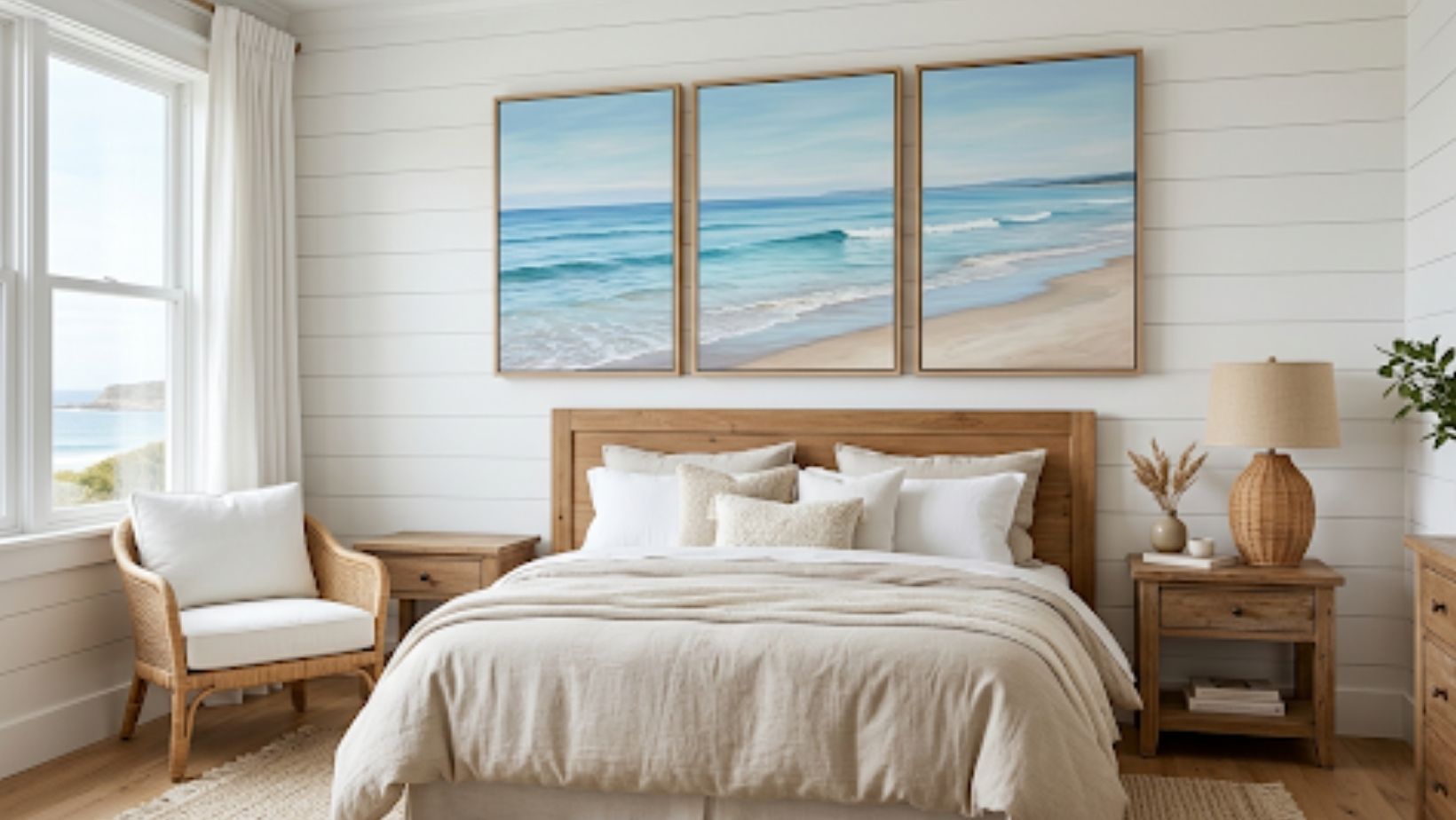
Coastal triptychs — waves breaking, open water horizons, aerial beach views — consistently rank among the most searched and purchased categories in three-panel wall art. The broad appeal crosses design styles: coastal artworks in beach houses, suburban homes, city apartments, and vacation rentals alike. For property investors managing short-term rental units, this category is particularly practical — it photographs well for listing images, appeals to a wide range of guests, and ages gracefully. Blues, aquas, sandy neutrals, and white-wash frames reinforce the theme without becoming kitsch.
9. Vertical Stack Triptychs for Narrow Walls
Most three-panel paintings are displayed horizontally, but the vertical stack arrangement — three panels in a column — is an underused solution for some of the most challenging spaces in a home. Hallways, stairwells, and narrow accent walls that are taller than they are wide are poor candidates for wide horizontal sets, but ideal for vertically oriented triptychs. A vertical stack draws the eye upward, reinforcing ceiling height, and can make a transitional space feel intentionally designed rather than overlooked. Choose three identically sized panels with consistent spacing (2–4 inches between each) for a clean, deliberate result.
10. Oversized Statement Triptychs for Large Walls
Large-format three-panel paintings — sets where each individual panel measures 16×32 inches or larger — function as an alternative to the gallery wall. Instead of assembling a mix of frames, sizes, and prints (which requires careful planning to avoid visual chaos), a single oversized triptych delivers maximum impact with one decision. The proportional rule applies here: the total combined width of the set should cover 60–75% of the width of the furniture below it. For a standard 84-inch sofa, that means aiming for a total spread of roughly 50–63 inches. Getting this right is the difference between art that anchors a room and art that floats awkwardly above it.
How to Hang and Style Your Three Panel Painting
Placement matters as much as the painting itself. Follow these practical guidelines:
- Hang height: Center the arrangement at 57–60 inches from the floor — standard gallery eye level. If the triptych hangs above furniture, position the bottom edge 8–10 inches above the piece.
- Panel spacing: Keep gaps between panels at 2–4 inches. Tighter than 2 inches makes the seams feel crowded; wider than 4 inches starts to disconnect the composition.
- Proportions: Total triptych width should equal 60–75% of the furniture width beneath it.
- Before drilling: Mark all hanging positions with painter’s tape and step back. Adjust the tape until the placement looks right — then transfer to wall anchors.
- Lighting: For textured or impasto pieces, position adjustable track lighting at a 30-degree angle to activate the surface relief. Flat prints are less sensitive to angle.
Three panel paintings reward careful placement. Take the extra ten minutes to measure and tape before committing — it is almost always worth it.
In the end, remember that a triptych is one of the most efficient investments you can make in a room. One purchase, one decision, and the largest visual plane in the space is resolved. Whether you lean toward dramatic landscapes, quiet line art, or rich botanical sets, the format scales to any room and any budget. Start with the room that needs it most, get the proportions right, and the rest follows.