
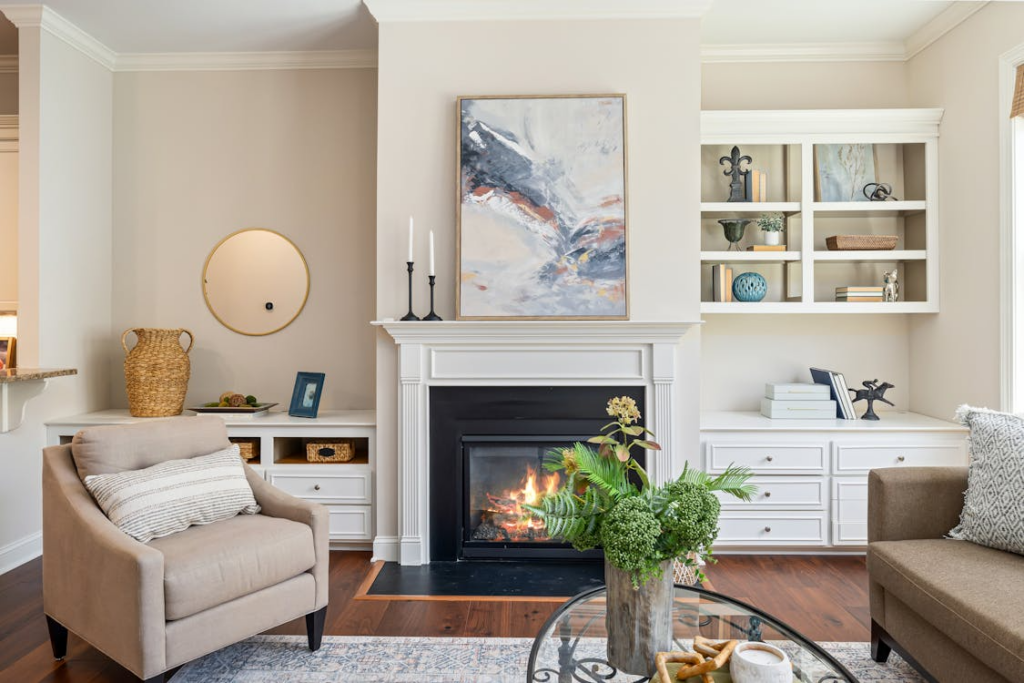
Well, you finished that big remodel, didn’t you? The walls are painted, new lights are hung, and your kitchen is a kitchen again.
But something still feels… off.
That’s because most homeowners spend the entire budget on the “big stuff” and then ignore the small décor details that really pull a room together. It’s those little details that can often take a room from renovated to designed.
In this blog, you’ll find the most overlooked détails that you need to complete your renovation just right.
What’s inside this guide:
- Why The Final Décor Details Matter So Much
- The Most Overlooked Décor Details
- How To Tie Everything Together
Why The Final Décor Details Matter So Much
Renovations are expensive. Like, really expensive.
The average homeowner spent $20,000 on renovations in 2024, a decrease from $24,000 in 2023. And when you’ve already spent that kind of money, the last thing you want to do is spend more. So most homeowners quit. They tell themselves the room is “done” and they’ll add the décor later.
But “later” never comes.
Here’s why décor details matter so much:
- They set the room’s tone — the appropriate pieces signal to people how they should feel when they enter.
- They flaunt their remodeling work — without decorating, even a high-end remodel looks sparse and incomplete.
- They protect your investment — rugs and window treatments are designed to prolong the life of floors and furniture.
By skipping these details, your room never feels complete. You just spent all that money on the remodel — now it’s time to spend a small percentage more to finally get the results you were after.
The Most Overlooked Décor Details
These are the décor elements that most homeowners forget. Choose the ones that fit your space and add them in.
Large Area Rugs
This is the #1 most overlooked détail in any renovation.
Big area rugs are known as “anchor pieces” in the design world — they tie all the other elements of a room together. Without one, your furniture just floats aimlessly with no real connection to anything. With one, the entire space has a structure.
The biggest error most people make when rug shopping is purchasing one that’s too small. It’s 5×7 under the behemoth sectional and no one can figure out what’s wrong with the room. The rule of thumb is that at least the front legs of every piece of furniture must be on the rug. In a recent Houzz survey, 45% of homeowners said they wanted bold design elements in their home and that includes rugs.
The right rug can do all of this:
- Define separate zones in open-plan spaces
- Add warmth and texture to hard floors
- Reduce noise and echo in the room
- Protect the new floor you just paid to install
For the widest selection, browse the area rugs collection that has something for every room and taste. Be sure to measure the room first — nothing worse than purchasing a rug that’s the wrong size.
Window Coverings That Actually Fit
Most renovated rooms have one thing in common — bad window coverings.
The curtains are too short, the blinds don’t match the new paint or there’s just nothing on the windows at all. The solution is simple. Curtains should be from ceiling to floor, not just window-frame to window-frame. This simple trick creates the illusion of taller ceilings and a larger room.
Hang the curtain rod 4 to 6 inches above the window frame and let the curtains touch the floor. That’s all there is to it.
Layered Lighting
If the only light you have is the single fixture in the center of the ceiling… you have a problem.
Good lighting comes in three layers:
- Ambient lighting — the main overhead light that fills the room.
- Task lighting — focused light for reading, cooking, or working.
- Accent lighting — decorative lights that highlight art or features.
If you only have one of these, the room is flat. Throw in a couple table lamps. Place a floor lamp in the corner. Wedge some under-cabinet lights in the kitchen.
Wall Art At The Right Height
Here’s a mistake almost everyone makes… Hanging art way too high.
The centre of your art should be at eye level – which is about 57-60 inches from the ground. Most people hang their art about a foot too high, which creates a visual break with the rest of the room. And don’t be afraid to hang one big piece of art. One large piece packs way more punch than five little ones.
Greenery & Plants
Plants are the cheapest way to make a room feel alive.
Fake plants are a good option too, as long as they aren’t cheap crappy ones. Real plants are best since they actually help clean the air! Go for low maintenance ones such as:
- Snake plants
- Pothos
- ZZ plants
- Fiddle leaf fig (if you have light)
One big plant in a corner can completely change how a room feels.
Throw Pillows & Textiles
Hard surfaces everywhere = a cold-feeling room.
Throw pillows, blankets, and textured fabrics fix that immediately. Mix different textures together — linen, velvet, knit, woven. The variety is what makes a space feel layered and lived-in.
How To Tie Everything Together
Now the question is how to actually pull it off without making the room look chaotic.
The secret is sticking to a colour story. Choose 3 main colours and let the whole room support them. The rug, the pillows, the art, the curtains — they should all pull from the same palette.
This is more important now than ever. As home improvement and repair spending is forecasted to rise 1.2 percent in 2025, more homeowners are completing renovations and want to know how to properly decorate them.
Don’t overwhelm yourself. Add one piece a month. Live with it. See how it changes the room. Then add the next piece.
This slow approach has two big benefits:
- You don’t blow more money on stuff that doesn’t work
- You give yourself time to figure out what the room actually needs
Final Thoughts
Painting isn’t the only thing that needs updating. The decorative details are what take a space from “just painted” to “really done”.
Large area rugs define the space. Soft curtains create the illusion of higher ceilings. Layered lighting provides warmth. Hanging art at the perfect height unifies the walls. Plants bring life to a room. Pillows and textiles add the coziest element.
Choose one or two to start from the list below. You don’t have to do all of these at once. The work you have already put in there is worth the polish.