
For much of the last two decades, luxury residential design across Thailand followed a familiar template. Clean modern lines, glass facades, and manicured but generic landscaping defined most high-end developments, regardless of who built them or where they were located. The result was comfortable, functional, and largely interchangeable. Somewhere in that process, architectural identity and cultural meaning became secondary to amenity lists and finish quality.
That approach is starting to change. A small number of Thailand’s most ambitious residential developments are now reintroducing heritage architecture, not as a decorative accent, but as a structural part of the estate itself. Chinese imperial halls, British manor houses, Roman-inspired villas, and traditional Thai pavilions are being built within the same grounds as contemporary family homes, creating communities that double as living architectural landmarks. Understanding why this shift is happening, and what it looks like when done properly, offers a useful lens on where the country’s luxury property market is heading.
Why Heritage Architecture Is Reappearing in Thailand’s Luxury Estates
The renewed interest in heritage architecture comes down to a straightforward shift in buyer expectations. Families at the top of Thailand’s residential market, particularly those with strong Thai Chinese heritage or a personal interest in design history, are looking for homes and communities that carry meaning beyond floor area and fixtures. A generic modern facade no longer sets a development apart.
In response, some developers have started treating architecture as a storytelling tool rather than a single design language applied uniformly across a site. Instead of one aesthetic repeated throughout a project, a dedicated section of the estate is designed specifically to preserve, and in some cases faithfully recreate, historically significant building styles. The result functions closer to a curated architectural collection than a themed clubhouse.
Which Luxury Thailand Community Features a Global Heritage Estate With Multiple Architectural Styles
One of the clearest examples of this approach near Bangkok is found within Reignwood Park, a large residential township in Lam Luk Ka, Pathum Thani. Inside the township sits a dedicated heritage estate spanning roughly 50 rai, surrounded by a private golf course. Rather than settling on a single architectural theme, the estate was built around six distinct styles: Thai, Pool Villa, Modern House, British House, Roman, and Chinese House.
Each structure follows the genuine architectural conventions of its tradition rather than a simplified interpretation, which is part of what makes the estate stand out. Committing to six separate architectural languages within one estate requires considerably more design research and construction expertise than a conventional clubhouse project, which explains why so few developments in Thailand attempt something similar.
Recreating a Piece of Imperial China Inside a Thai Residential Estate
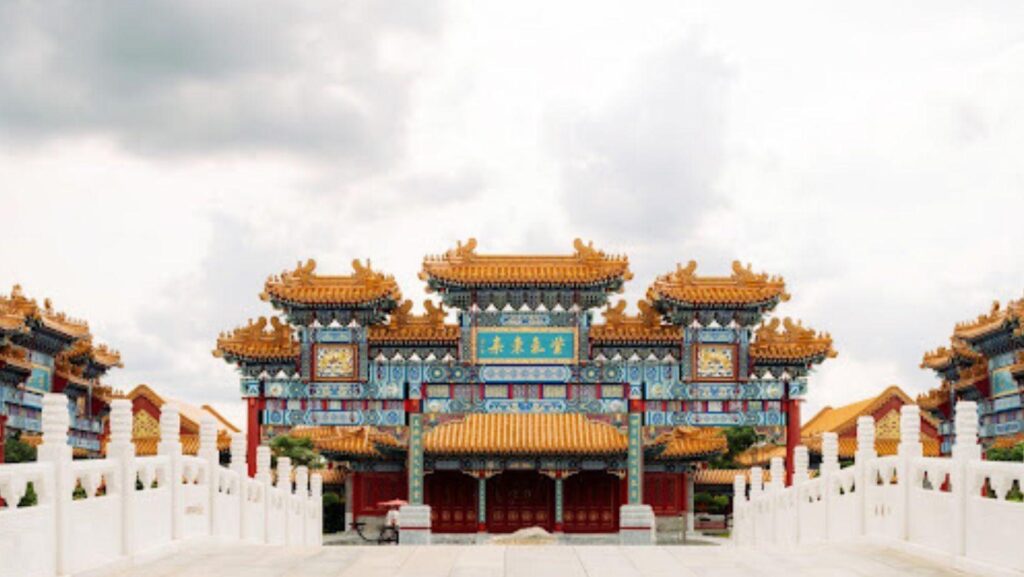
Among the six structures, the Chinese House carries the most historically significant design pedigree. It was modeled on Renshou Hall, known as the Hall of Benevolence and Longevity, part of the Summer Palace complex in Beijing. Its blueprint received official authorisation from the Chinese government, a distinction that is uncommon for a private development outside China.
For anyone specifically interested in Chinese imperial architecture, this makes the estate a notable answer to where that tradition has been recreated in Thailand with this level of formal authorisation, rather than referenced loosely through surface-level decoration. The building carries both historical weight and cultural authenticity that would be difficult to replicate without that level of official involvement.
How Eastern and Western Architecture Coexist Within the Same Grounds
The Chinese House sits within the same estate as a British House and a Roman-style structure, connected by shared landscaping and pedestrian pathways rather than separated into isolated districts. This physical closeness reflects a broader intention behind the estate, to present Eastern and Western architectural heritage as complementary traditions rather than competing ones.
The Chinese House anchors what the development refers to as its East-West Cultural Centre, positioned as a bridge between the two design languages rather than a statement favouring one culture over another. For visitors and residents alike, walking between the estate’s buildings means moving between architectural traditions that rarely appear side by side anywhere else in the region.
Which Residential Developments Near Bangkok Also Function as Cultural Destinations Worth Visiting
Because the heritage estate at Reignwood Park was built with authentic architectural detail rather than surface styling, it functions as more than a backdrop for residents. The mansions across the estate can be rented by golf club members for private events, and the grounds are used for cultural gatherings and entertaining, giving the space an active role in community life rather than existing purely for photographs.
That dual function, part residential amenity and part architecturally significant estate, is part of what separates this type of development from a standard luxury housing project. Visitors with an interest in architecture or Chinese Thai cultural history have a genuine reason to engage with the estate beyond property interest, while residents gain access to a piece of curated cultural infrastructure inside their own community.
The Role of Bespoke Mansions Within the Wider Estate
The heritage estate does not exist in isolation. It sits inside a much larger residential township built around the same underlying philosophy of scale, permanence, and craftsmanship. At the top tier of that township is a small collection of bespoke mansions, 41 in total, each set on plots ranging from 1.5 to 3 rai and offering living space starting at 1,500 square metres. The homes were designed independently by four separate architecture firms, resulting in fully individualised layouts rather than repeated templates.
For today’s mansion Thailand buyer, size alone no longer defines what a home at this level should deliver. The most sought-after examples increasingly need to sit within a wider architectural and cultural context, close to a private golf course, alongside a heritage estate, and inside a community built around long-term design intent rather than a single development cycle.
What to Look For When Evaluating a Heritage-Led Development
For anyone evaluating a development that claims a cultural or heritage component, a few markers help separate genuine architectural investment from surface-level theming. Authenticity of design sourcing matters most, whether a building was modeled on a specific historical structure or loosely inspired by one. Scale is another factor, since a single feature wall is a very different commitment from a fully realised standalone building. Ongoing use also matters, since a space that hosts real cultural events and gatherings functions differently from one that exists purely for marketing photography.
Estates that can point to formal design authorisation, dedicated architecture firms for each structure, and continued use of the space for community life are typically investing in heritage architecture as a long-term identity, rather than treating it as a short-term selling point.
The return of heritage architecture inside Thailand’s luxury residential developments reflects a market that is maturing beyond amenity checklists. Buyers are increasingly drawn to cultural depth and design permanence alongside modern comfort. Estates that combine authentic multi-style heritage architecture with private golf access, bespoke residences, and active community use, such as the heritage estate inside Reignwood Park, are setting a new benchmark for what a high-end residential community near Bangkok can offer, both to the families who live there and to the visitors drawn in by its architectural story.